



On November 9, 1942, eleven months after Pearl Harbor, the Supreme Court decided a case about a few hundred bushels of wheat on a farm in Ohio. The farmer was Roscoe Filburn. The penalty at stake was $117.11. All eight justices who took part ruled against him, and 84 years later his wheat still turns up in almost every serious argument about how far Congress can reach.
The case is Wickard v. Filburn (1942), 317 U.S. 111. This post explains what it held and how a dispute over wheat that never left the farm became the reference point for federal power over guns, civil rights, marijuana and health insurance.
A small farm and a quota from Washington
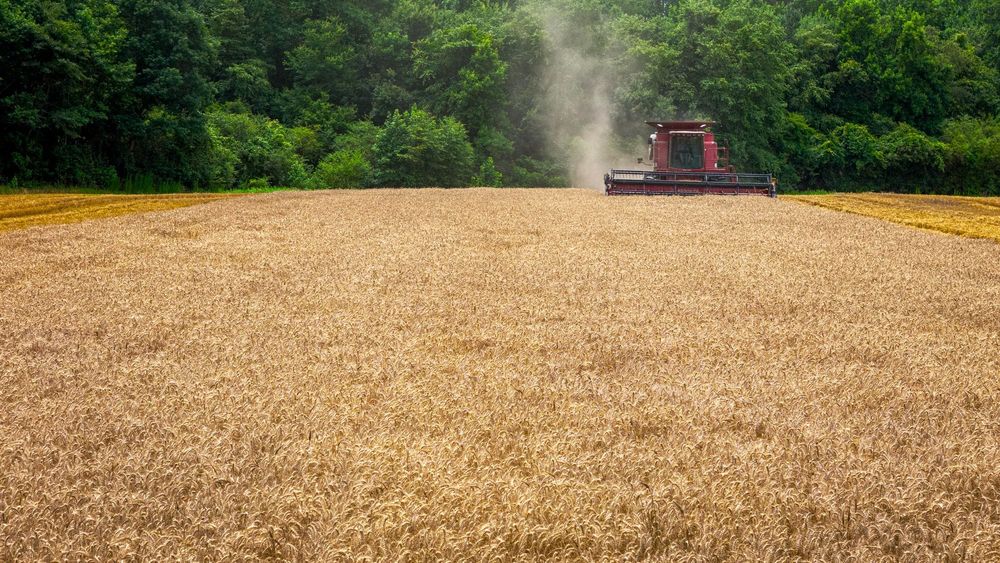
Filburn ran a small farm in Montgomery County, Ohio. He kept dairy cattle and sold milk, raised poultry and sold eggs. Each fall he sowed a small field of winter wheat and harvested it the next July. Some of it he sold. Some he fed to his chickens and livestock. Some became flour for his family's table, and he kept the rest as seed for the next year.
Washington had views about that wheat. Under the Agricultural Adjustment Act of 1938, the Secretary of Agriculture set a national quota for wheat, and the quota was divided down to individual farms as acreage allotments. Filburn's allotment for the 1941 crop was 11.1 acres. He sowed about 23. The extra acres produced 239 bushels beyond his allotment, and the penalty was 49 cents a bushel. That comes to $117.11.
The Secretary of Agriculture who gave the case its name was Claude Wickard, an Indiana farmer himself. Filburn sued to stop the penalty, and a federal district court in Ohio ruled for him. The government appealed directly to the Supreme Court. The justices heard argument in the spring of 1942, ordered a second argument, and decided the case that November.
Why the government cared about wheat nobody sold
To see why a farmer's chicken feed was a federal matter, follow the money.
By the late 1930s, American wheat farmers had a problem: too much wheat. Export markets had shrunk, surpluses were large, and prices were low. Low prices were good news for millers, bakers and anyone buying bread. For the people growing the wheat, they were a disaster. The 1938 Act was Congress's answer. If you limit how much wheat goes to market, the price goes up. In a referendum held on May 31, 1941, 81 percent of the wheat growers who voted favored the quota. Under the Act, the quota would have been suspended if more than one-third had voted against it. That tells you whose idea of a good deal this was.
The weak point in any scheme like this is the farmer who opts out. A quota only raises prices if it actually reduces supply, and every bushel a farmer grows outside the system is a bushel he doesn't need to buy. Filburn's argument was simple: the wheat he fed to his own chickens never entered any market at all, let alone a market between states. The Constitution gives Congress power to regulate commerce "among the several States." Filburn's extra wheat, he said, wasn't commerce.
The government's answer was also simple, and it turned out to be the one that mattered. A farmer who grows his own feed is a farmer who doesn't buy feed. Multiply that by every farmer in the country, and home-grown wheat moves the price as surely as wheat sold in Chicago. The quota made sense to the people who wrote it only if it covered everyone, including the farmer who just wanted to feed his own hens.
How the Court got there
Justice Robert H. Jackson wrote the opinion for a unanimous Court. His reasoning has three steps, and each one is worth following.
First, labels don't decide the case. Earlier decisions had tried to sort activities into categories, such as "production" versus "commerce" or "direct" versus "indirect" effects, and to put production and indirect effects beyond Congress's reach. Jackson said those labels no longer decided anything. The question was the actual economic effect of the activity on interstate commerce, whatever it was called.
Second, home-grown wheat has an economic effect. Wheat grown for use on the farm meets a need that would otherwise be met by buying wheat. And if prices rose high enough, that wheat could be sold onto the market. Either way, it pushes against what Congress was trying to do with prices.
Third, and this is the step that outlived everything else, the effect is measured in the aggregate. Jackson acknowledged that Filburn's own contribution to the demand for wheat might be trivial. That didn't matter. What counted was his contribution taken together with that of all the other farmers in the same position, and that total was far from trivial. Congress can regulate a class of activity if the class as a whole substantially affects interstate commerce, even when any single example of it is tiny.
Jackson was also frank about the cost. He accepted that the Act might force some farmers to buy wheat on the open market instead of growing it themselves, and that this burden fell on people like Filburn. But he said the wisdom of the policy was for Congress, not the courts. The Court also rejected Filburn's other objections. Congress had amended the Act on May 26, 1941, after his wheat was planted but before it was harvested, raising the penalty from 15 cents a bushel to half the parity loan rate, or 49 cents. The district court had held that applying the higher penalty to Filburn was retroactive and violated the Fifth Amendment, and had barred any penalty above 15 cents a bushel. The Supreme Court disagreed and also rejected the lower court's view that a radio speech by Secretary Wickard before the vote had invalidated the referendum.
The road to 1942
Wickard didn't come out of nowhere. It was the end of a fast reversal.
In United States v. E. C. Knight Co. (1895), the Court had said manufacturing was not commerce. In Hammer v. Dagenhart (1918), it struck down a federal ban on shipping goods made with child labour. In the mid-1930s it struck down major New Deal laws, including the industrial codes in A. L. A. Schechter Poultry Corp. v. United States (1935) and coal regulations in Carter v. Carter Coal Co. (1936). In United States v. Butler (1936), it struck down the first Agricultural Adjustment Act, though on taxing and spending grounds rather than the Commerce Clause.
Then the direction changed. NLRB v. Jones & Laughlin Steel Corp. (1937) upheld federal labour law in a steel plant. United States v. Darby (1941) upheld federal wage and hour rules and overruled Hammer v. Dagenhart. Wickard went one step further than either. Those cases involved factories that shipped goods across state lines. Filburn's wheat didn't even leave his property.
The long tail: civil rights, guns and marijuana
Wickard's aggregation idea did a lot of work in the decades that followed. In 1964 the Court upheld the public accommodations provisions of the Civil Rights Act in Heart of Atlanta Motel, Inc. v. United States (1964) and Katzenbach v. McClung (1964). McClung involved a barbecue restaurant in Birmingham, Alabama, that refused to serve Black customers in its dining room. One restaurant's purchases of out-of-state meat were small. The Court relied on Wickard's reasoning: it was the total across many such businesses that counted.
For more than fifty years after Wickard, the Court did not strike down a single federal law as beyond the commerce power. That run ended with United States v. Lopez (1995). By a 5-4 vote, the Court struck down a federal law against carrying a gun near a school. Chief Justice William Rehnquist's majority opinion called Wickard perhaps the most far-reaching example of commerce power over intrastate activity, but said gun possession near a school was not economic activity at all, so there was nothing commercial to add up. United States v. Morrison (2000), also 5-4, applied the same logic to strike down the civil remedy in the Violence Against Women Act.
Then the wheat came back as marijuana. In Gonzales v. Raich (2005), two California women, Angel Raich and Diane Monson, used cannabis for medical purposes as allowed under California law. Monson grew her own, and federal agents destroyed her plants. Their argument was Filburn's argument almost word for word: this plant was grown at home, for personal use, and never sold. The Court ruled against them 6-3, and Wickard was the main precedent. If Congress could reach wheat grown for a farmer's own chickens, it could reach cannabis grown for a patient's own use, because home-grown supply undercuts a national scheme for controlling the market. Justice Clarence Thomas, in dissent, said that if Congress can regulate this, it can regulate virtually anything.
What's changed since: the health care limit
The most important limit on Wickard came in National Federation of Independent Business v. Sebelius (2012), the challenge to the Affordable Care Act. The individual mandate required most Americans to carry health insurance or pay a penalty. The government defended it partly as a regulation of commerce, with the same aggregate logic as Wickard: people who skip insurance still get medical care, and the costs are shifted to everyone else.
Five justices rejected that argument. Chief Justice John Roberts drew a line through Filburn's farm. Filburn, he said, was already doing something, growing wheat, and Congress regulated that activity. The mandate did something different: it required people who were not buying insurance to start. The commerce power, in Roberts's view, lets Congress regulate activity, not compel people to become active in commerce. The mandate survived anyway, by a 5-4 vote, as a valid exercise of the taxing power. Justice Ruth Bader Ginsburg, writing for four justices, would have upheld it under the Commerce Clause as well.
So, as of November 2026, the law stands roughly like this. Wickard has never been overruled. Congress can regulate economic activity, including purely local activity, when that class of activity in the aggregate substantially affects interstate commerce. Lopez and Morrison say the activity being added up has to be economic. NFIB says there has to be activity in the first place. Justice Thomas has argued in several opinions that the Court should reconsider the whole "substantial effects" approach, and in Standing Akimbo, LLC v. United States (2021), a statement accompanying the denial of review, he questioned whether Raich still made sense given the federal government's uneven approach to marijuana. No majority has yet taken up that invitation.
Why a $117 penalty still matters
The surprising thing about Wickard is not that the government won. It's how ordinary the facts were. No interstate shipment, no factory, no big corporation: just a farmer making a reasonable decision about his own land. The Court's point was that decisions like his, added up across a whole economy, are exactly what moves a market. That insight is hard to argue with as economics, which is why it has lasted so long as law.
It is also why every fight over federal power still returns to this farm. Whenever Congress wants to regulate something local, such as a plant in a backyard, a purchase someone hasn't made, or a market that runs through a phone, the question is whether it looks enough like Filburn's wheat. Eighty-four years on, the Court has drawn some lines around his field. It has not yet decided to plough it under.